
Tampilkan postingan dengan label technology. Tampilkan semua postingan
technology

Killer robots have officially gone out to sea. For the first time, the Navy has fired missiles from a remote-controlled boat, as shown in the video above.
The firing came as part of a test off the Maryland coast on Wednesday. Six of Rafael’s anti-armor Spike missiles got fired off a moving inflatable hulled watercraft, aiming for a floating target about two miles away. The missile firings and the boat’s controls were all handled remotely by Navy personnel on shore at the Navy’s Patuxent River base.
It’s the “first significant step forward in weaponizing surface unmanned combat capability,” Mark Moses, the Navy’s program manager for the armed drone boat project, tells Danger Room. Sure, the U.S. military has no shortage of armed robotic planes and — soon — helicopters. But it doesn’t have weaponized drones that patrol the seas, either above it or below it. The Navy’s early experiments with robotic submarines are for spying and mine clearance, not for attack. Until this week’s tests at Pax River, the Navy didn’t have a robotic surface vessel capable of firing a weapon — the fulfillment of a goal the Navyset for itself in 2007.
The Navy’s been tricking out this 11-meter inflatable boat for the past several years at its base in Newport, Rhode Island, to do just that. Mounted on the boat is a dual-pod missile launcher and an Mk-49 mounting system, all made by Rafael and fully automated, which the Navy’s calling a “Precision Engagement Module.” The Navy seems the module as the sort of thing that could protect U.S. coastline without danger to sailors or coastguardsmen, or prevent pirates or Iranian sailors from maneuvering their small, fast boats between targets that Navy Destroyers can’t risk hitting.
The Precision Engagement Module “could be used in a number of applications including harbor security, defensive operations against fast attach craft and swam scenarios, which is of primary concern for the Navy,” says Moses. “However, it is probably most effective when targets try and hide among commercial vessels –for example, congested waterways.”
In three days’ worth of tests at Pax River this week, the Navy shot off the long-range version variant of the Spike, a 30-pound missile with an effective range of about 2 and a half miles. The video above shows six of the remote firings — and while they looked to our untrained eyes like near misses, the Navy says that’s a trick of the camera angle, and they actually hit their targets.
All this is just a demonstration; it’ll be years and many more tests before the Navy decides if it wants to purchase a fleet of remote-controlled, missile-packing boats. But “the increase in attention and effort for water borne technological advancements coincides with the drawing down of U.S. military resources in the land locked campaign in Afghanistan,” Mark notes, “and a strategic refocusing to problem regions where unconventional maritime threats must be accounted for.” In other words: put the robo-boat off Iranian or Somali waters, and let sailors at a safe distance aim and fire its missiles, much like the Air Forces drone pilots do.
technology × Teknologi
You're in fast moving traffic on a busy motorway approaching a complicated junction with just seconds to get into the right lane. Your phone, sensing that now is not the moment to disturb you, diverts an incoming call straight to voicemail. Later, when you are in a more relaxed state, it plays the message back and offers to ring the caller back.
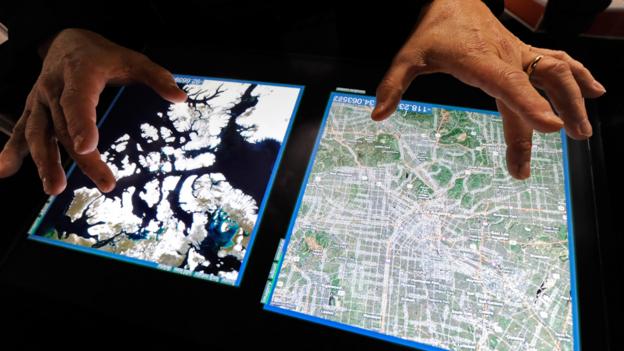
Even if you are packing an iPhone 5 or the latest Samsung, it is fair to say that your phone is still a long way from doing this. Despite the impressive array of features offered by today's handsets – including voice commands - most people still interact with their phones by pressing buttons, prodding a screen or the occasional swipe or pinch.
It is a similar story with computers. Take Microsoft’s new Windows 8 operating system, due to be launched later this week. Its colourful, tile-laden start screen may look startlingly different to older versions of Windows, but beneath the eye candy it's still heavily reliant on the keyboard and mouse.
In fact, with one or two notable exceptions, it is striking just how little the way we interact with computers has changed in the last few decades.
"The keyboard and mouse are certainly a hard act to follow," says George Fitzmaurice, head of user interface research for US software maker Autodesk. But, despite an apparent lack of apparent novelty in the majority of interfaces of today's mass market devices, there are plenty of ideas in the pipeline.
Take, for instance, technology that can monitor your stress levels. One technique being developed is functional near-infrared spectroscopy(fNIRS) that monitors oxygen levels in the blood, and therefore activity, in the front of the brain. "It measures short term memory workload, which is a rough estimate of how 'busy' you are," says Robert Jacob, professor of computer science at Tufts University, near Boston, Massachusetts.
The technology is currently used in medical settings, but could one day be used to help filter phone calls, for example. Today fNIRS works via a sensor placed on your forehead, but it could also be built into baseball caps or headbands, allowing the wearer to accept only important calls. Perhaps more immediately, it could also help organisations assign workloads efficiently. "You could tell your phone only to accept calls from your wife if you get busy beyond a certain gradation of brain activity," adds Jacob. "If a machine can tell how busy you are it can tell if you can take on an additional workload, or it could take away some of your work and assign it to someone else if you are over-stretched."
Other forms of "brain-computer interface" are already being used and developed for a growing number of applications. Electroencephalography (EEG) picks up electrical signals generated by brain cell interactions. It has long been used to diagnose comas, epilepsy and brain death in hospitals and in neuroscience research. The variation of frequencies of signals generated can be used to determine different emotions and other brain states. Recent years have seen the launch of simplified EEG headsets that sell for as little as $100.
For example, a British company called Myndplay makes interactive short films, games and sports training software which users interact with via these brain wave measuring headsets. Those who can successfully focus their minds or mentally relax sufficiently when required can influence film plots and progress to higher levels in games.
Similar technologies are increasingly being used to help the disabled. Two years ago an Austrian company called Guger Technologies released a system designed to help paralysed patients type by highlighting letters on a grid one by one until the desired letter is selected and the associated EEG signal is detected. Spanish researchers have developed EEG-controlled wheelchairs and are working on using the same method to control prosthetic arms.
technology
By Philip Elmer-DeWitt October 22, 2012: 12:15 PM ET
He says it has two cameras, a more refined back casing and some surprises
White

The 9.7-inch iPad with mock-up of a 7.85-inch version. 9to5Mac.
FORTUNE -- In one of his dispatches from a tour of Apple's (AAPL) Asian supply chain two weeks ago, Topeka Capital's Brian White mentioned that an iPad case-maker let him handle what they claimed was a prototype iPad mini.
In note to clients Monday -- in which White reminded them that it was he who first coined the name iPad Mini (with a captital M) -- he expanded on his brief remarks. Under the heading "Smaller, Lighter, More Refined & Easily Tucked into a Jacket or Purse," he writes:
During our recent China-Taiwan Tech Tour, we had the opportunity to play with a pilot version of the "iPad Mini" that easily fit into our sport coat pocket. Experiencing a new form factor of an iconic product such as the iPad is a sight to behold and we believe consumer demand will reflect this phenomenon. We expect the "iPad Mini" to be 7.85 inches in size, include two cameras, come with the option of Wi-Fi only or Wi-Fi and 4G/3G, include the new lightening connector, start at lower storage capacity (8GB) than the iPad, sport a more refined back casing, come in slightly different color variation (i.e., similar to iPhone 5) and offer some surprises. We expect the "iPad Mini" to begin at a price point of $250-$300.
His description of the device Apple is expected to unveil Tuesday in San Jose is not much different than other analysts', but it's coming from the only guy who claims to have put one in his pocket.
technology
Nowhereelse.fr points to two new photos originally posted to Chinese forumWeiphone. The photos appear to be the front and back of the next generation iPhone logic board which houses the processor and other support chips for the device. The board is distinct from both the Apple's iPhone 4S and iPhone 4 logic boards.

 Nowhereelse notes that the screw holes of the logic board lines up exactly with those of the previously leaked shells The site even created this animated GIFwhich shows how the holes line up. The image appears to be mirrored, presumably for clarity
 We've seen a larger number of part leaks for the next generation iPhone, but this is not a new phenomenon. Last year, we saw many parts for what would become the iPhone 4S, including its logic board revealing an A5 processor. This leak is somewhat less revealing as much of the shielding remains in place.
The increased number of part leaks likely corresponds to the belief that Apple is already ramping up production of the next generation iPhone. Apple is expected to launch the new iPhone on September 12th.
source: http://www.macrumors.com/2012/08/12/leaked-photos-of-the-iphone-5-logic-board/
We've seen a larger number of part leaks for the next generation iPhone, but this is not a new phenomenon. Last year, we saw many parts for what would become the iPhone 4S, including its logic board revealing an A5 processor. This leak is somewhat less revealing as much of the shielding remains in place.
The increased number of part leaks likely corresponds to the belief that Apple is already ramping up production of the next generation iPhone. Apple is expected to launch the new iPhone on September 12th.
source: http://www.macrumors.com/2012/08/12/leaked-photos-of-the-iphone-5-logic-board/
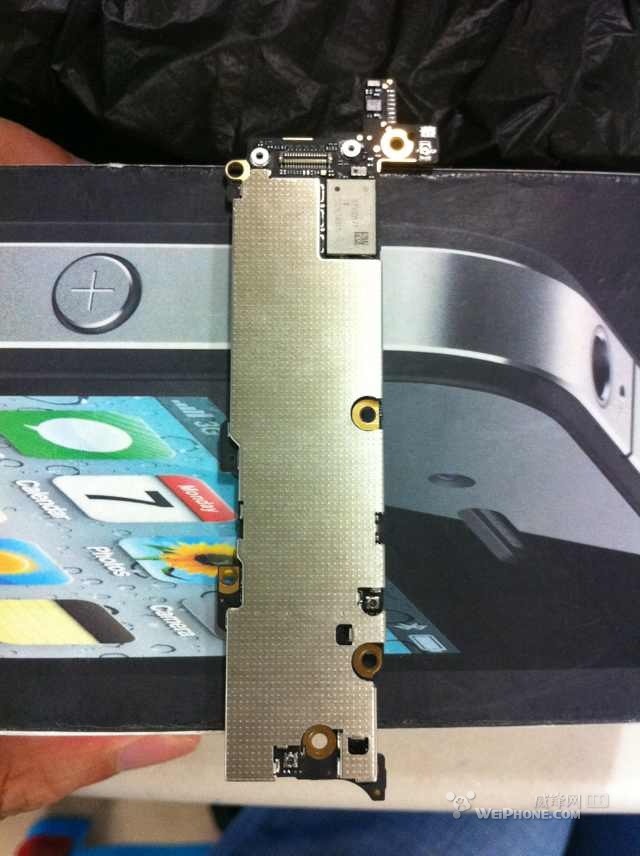
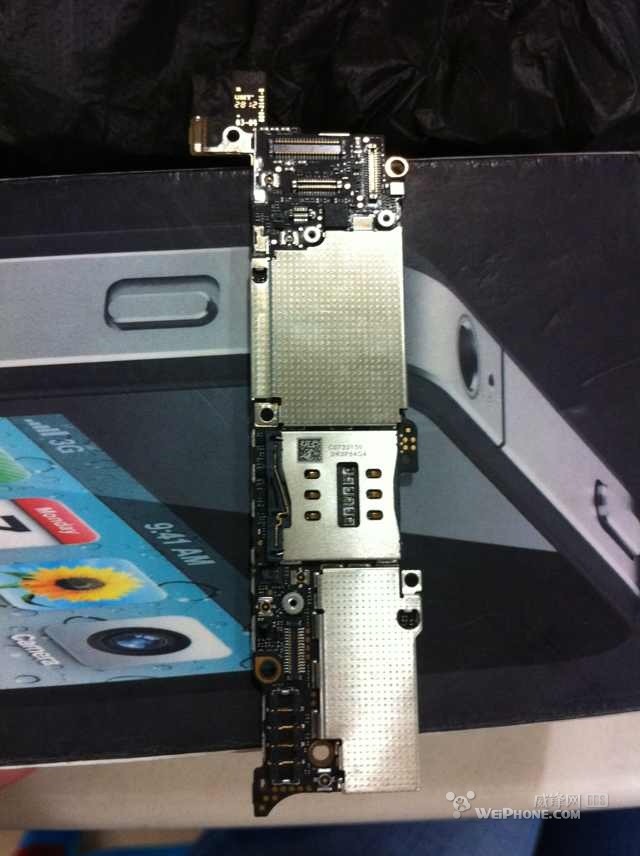 Nowhereelse notes that the screw holes of the logic board lines up exactly with those of the previously leaked shells The site even created this animated GIFwhich shows how the holes line up. The image appears to be mirrored, presumably for clarity
 We've seen a larger number of part leaks for the next generation iPhone, but this is not a new phenomenon. Last year, we saw many parts for what would become the iPhone 4S, including its logic board revealing an A5 processor. This leak is somewhat less revealing as much of the shielding remains in place.
The increased number of part leaks likely corresponds to the belief that Apple is already ramping up production of the next generation iPhone. Apple is expected to launch the new iPhone on September 12th.
source: http://www.macrumors.com/2012/08/12/leaked-photos-of-the-iphone-5-logic-board/
We've seen a larger number of part leaks for the next generation iPhone, but this is not a new phenomenon. Last year, we saw many parts for what would become the iPhone 4S, including its logic board revealing an A5 processor. This leak is somewhat less revealing as much of the shielding remains in place.
The increased number of part leaks likely corresponds to the belief that Apple is already ramping up production of the next generation iPhone. Apple is expected to launch the new iPhone on September 12th.
source: http://www.macrumors.com/2012/08/12/leaked-photos-of-the-iphone-5-logic-board/


